
Google Cloud Architecture Diagram Examples: Real-World GCP Patterns for Production
Architecture diagrams are the difference between a system that runs reliably and one that fails in ways nobody understands. After years of deploying workloads on Google Cloud, from three-tier web apps to global data pipelines, I've learned that good diagrams are not just documentation; they're the blueprint that keeps teams aligned and incidents short.
This guide walks through production-ready GCP architecture examples you can adapt for your own workloads. Each pattern includes a concrete diagram, the services involved, and the tradeoffs you'll actually face when deploying it.
Cloud Architecture
Create cloud architecture diagrams for AWS, Azure, GCP, and more. Design scalable infrastructure with professional cloud icons.
Production-ready Google Cloud architecture diagram examples, three-tier web apps, GKE microservices, serverless, BigQuery pipelines, hybrid cloud, HA/DR, Vertex AI, and VPC networking.
Click Cloud Architecture to open AI Line Studio and generate diagrams from natural language in seconds.
Three-Tier Web Application on GCP
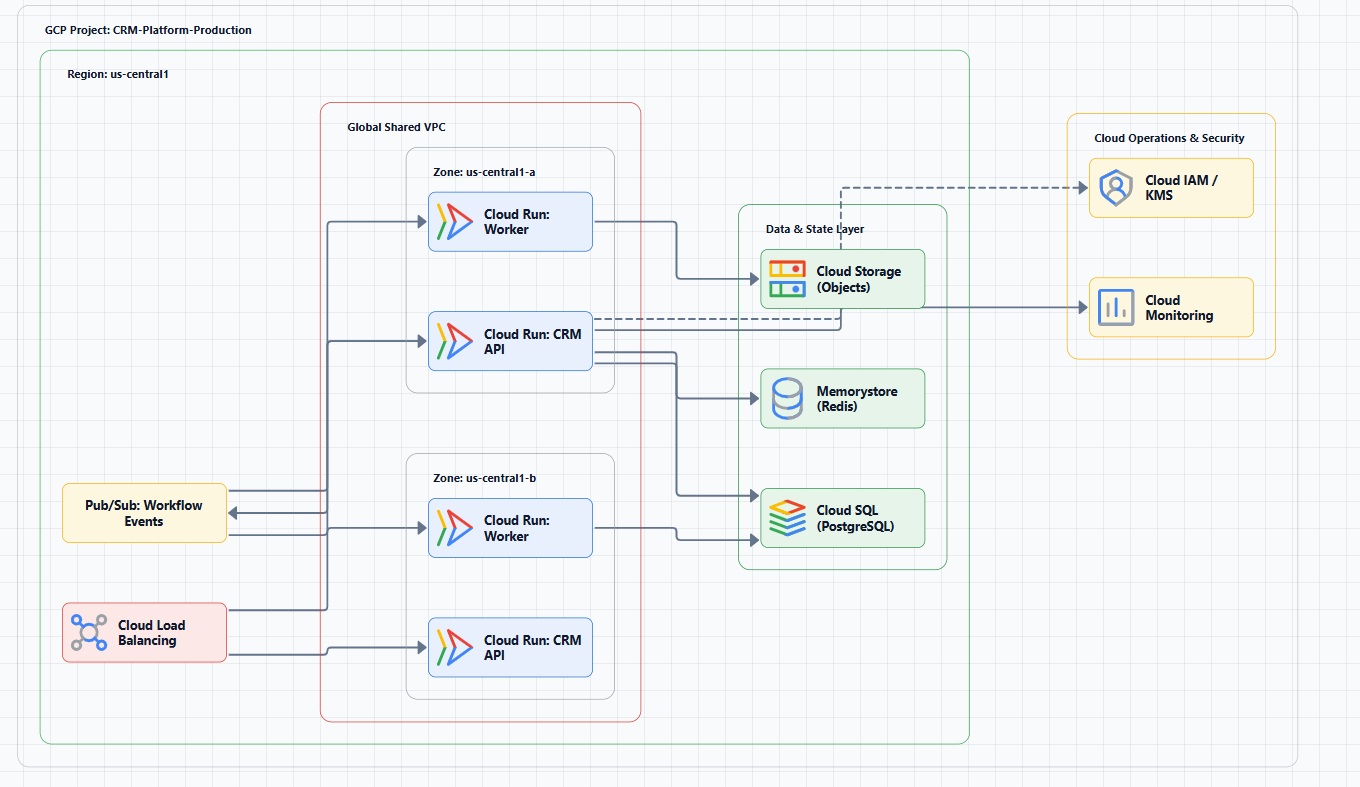
The three-tier architecture is the foundation for most web applications. It separates concerns into presentation, application, and data layers, allowing each to scale independently.
Example Diagram
A typical GCP three-tier setup looks like this:
- Web tier: Static assets hosted in Cloud Storage with Cloud CDN for global caching, or containerized frontends running on Cloud Run.
- Application tier: Business logic deployed as microservices on Google Kubernetes Engine (GKE) or as serverless functions with Cloud Run.
- Data tier: Cloud SQL (PostgreSQL/MySQL) for transactional data, with Memorystore (Redis) for session caching.
A global Cloud Load Balancer sits in front, routing traffic to the appropriate tier.
When to Use This Pattern
This is your default choice for most customer-facing web applications. It works well for e-commerce, SaaS platforms, and internal dashboards. The separation means you can scale the application tier independently from the database, and you can swap out the frontend without touching the backend.
When Not to Use It
Don't use this pattern for event-driven or batch processing workloads, you'll pay for idle compute. Also avoid it for simple CRUD apps that could run entirely on serverless with lower operational overhead.
Common Implementation Mistake
Over-provisioning the database. Many teams deploy a large Cloud SQL instance "just in case" and waste money. Start with the smallest instance that meets your performance needs, and use Cloud SQL's built-in read replicas to scale queries before upgrading the primary.
Microservices Architecture with GKE
Modern applications often decompose into microservices for faster development and independent scaling. GKE is Google Cloud's managed Kubernetes service, handling the control plane while you manage the nodes.
Example Diagram
A typical GKE microservices architecture includes:
- GKE cluster with multiple node pools (e.g., general-purpose for most services, compute-optimized for batch jobs).
- Istio service mesh for traffic management, observability, and security between services.
- Cloud Armor for WAF protection.
- Artifact Registry for container image storage.
- Internal load balancing for service-to-service communication.
The control plane runs the Kubernetes API server, scheduler, and controllers. Pods run on nodes that you manage in Standard mode, or GKE manages everything in Autopilot mode.
When to Use This Pattern
Choose GKE microservices when you have multiple teams owning different services, need fine-grained scaling, or are already invested in Kubernetes. It's also the right choice for migrating existing on-premises Kubernetes workloads to the cloud.
When Not to Use It
Avoid GKE if you're a small team with a monolithic application, the operational overhead isn't worth it. Also skip it if your workloads are predominantly batch or event-driven; serverless options like Cloud Run or Cloud Functions are simpler and cheaper.
Real Production Constraint
GKE clusters require careful planning around networking, IAM, and cost. A poorly configured cluster can run up a bill of thousands of dollars per month. Use GKE's cost-optimization features like node auto-provisioning and committed use discounts.
Serverless Application with Cloud Run and Cloud Functions
Serverless eliminates infrastructure management entirely. Cloud Run runs containers on demand, scaling to zero when not in use. Cloud Functions (now Cloud Run functions) executes single-purpose functions in response to events.
Example Diagram
A serverless architecture on GCP typically includes:
- Cloud Run services handling HTTP requests and containerized workloads.
- Cloud Run functions responding to HTTP calls, Pub/Sub messages, and Cloud Audit Logs.
- Pub/Sub for event-driven communication between services.
- Cloud Storage for file uploads and static assets.
- Firestore or Cloud SQL for data persistence.
Eventarc acts as the transport layer, automatically creating and managing Pub/Sub topics.
When to Use This Pattern
Serverless is ideal for low-traffic applications, event-driven workflows, and APIs with unpredictable traffic patterns. It's also excellent for background jobs, image processing, data transformation, notification sending, that don't require always-on infrastructure.
When Not to Use It
Don't use serverless for long-running computations (over 60 minutes), stateful workloads, or applications that require specific hardware (GPUs, high-memory instances). Cloud Run has a maximum timeout of 60 minutes, and Cloud Functions is even more restrictive.
Cost Tradeoff
Serverless is cheap at low traffic but can become expensive at sustained high throughput. If your application consistently handles thousands of requests per second, provisioned infrastructure (GKE or Compute Engine) will likely be more cost-effective.
Data Analytics Architecture: BigQuery + Dataflow
Google Cloud's data analytics stack is built for scale. BigQuery is a serverless data warehouse that processes petabytes in seconds. Dataflow (Apache Beam) handles stream and batch processing.
Example Diagram
A complete data pipeline on GCP looks like this:
- Ingestion: Events arrive via Pub/Sub (streaming) or are uploaded to Cloud Storage (batch).
- Processing: Dataflow transforms and enriches the data. Streaming pipelines consume from Pub/Sub, while batch pipelines read from Cloud Storage.
- Storage: Raw data lands in Cloud Storage (Bronze), processed data in BigQuery (Silver), and aggregated data in BigQuery (Gold), this is the medallion architecture.
- Orchestration: Cloud Composer (Apache Airflow) schedules and monitors pipelines.
- Visualization: Looker or Data Studio for dashboards.
When to Use This Pattern
This is the standard for any data engineering workload, real-time analytics, ETL/ELT, machine learning feature engineering, and business intelligence. It scales from gigabytes to petabytes.
When Not to Use It
Avoid this stack for small datasets (under 100 GB) or ad-hoc analysis, BigQuery's minimum storage and query costs make it uneconomical. Also skip it if your data sources are predominantly on-premises with low bandwidth; consider a hybrid approach first.
Performance Tradeoff
Dataflow streaming pipelines have higher operational complexity than batch. If your use case doesn't require sub-second latency, batch processing with scheduled Dataflow jobs is simpler and cheaper.
Event-Driven Architecture with Pub/Sub
Event-driven architectures decouple producers and consumers, improving resilience and scalability. Pub/Sub is Google Cloud's fully managed messaging service.
Example Diagram
An event-driven system on GCP includes:
- Event producers: Cloud Run services, Cloud Functions, or external systems publishing messages to Pub/Sub topics.
- Pub/Sub topics: Durable, scalable message queues that retain messages for up to 7 days.
- Event consumers: Cloud Functions, Cloud Run, or Dataflow pipelines subscribed to topics.
- Eventarc: Manages event routing from various Google Cloud sources.
When to Use This Pattern
Use event-driven architecture for order processing, log ingestion, IoT data pipelines, and webhook handling. It's also excellent for decoupling microservices, each service publishes events without knowing who consumes them.
When Not to Use It
Avoid Pub/Sub for request-response patterns where low latency is critical. The asynchronous nature adds milliseconds of overhead. Also skip it if you have fewer than three consumers, the complexity isn't justified.
Common Implementation Mistake
Not setting up dead-letter queues. Messages that can't be processed (due to schema changes or consumer bugs) will pile up and block the queue. Always configure a dead-letter topic and monitor its depth.
Hybrid Cloud Architecture
Many enterprises run workloads both on-premises and in the cloud. GCP provides multiple connectivity options: Cloud VPN, Cloud Interconnect, and Cross-Cloud Interconnect.
Example Diagram
A hybrid GCP architecture typically includes:
- On-premises data center: Running legacy applications and databases.
- Cloud VPN or Cloud Interconnect: Secure, high-bandwidth connection between on-premises and GCP.
- GKE Enterprise clusters running in both environments, managed centrally.
- Shared VPC: A central hub VPC with spoke VPCs for different teams or environments.
- Google Cloud Observability: Logging and monitoring data from on-premises clusters flows back to GCP for analysis.
When to Use This Pattern
Hybrid cloud is necessary when you have legacy systems that can't move to the cloud, data residency requirements, or gradual migration strategies. It's also common in regulated industries where certain data must remain on-premises.
When Not to Use It
Avoid hybrid if you can go all-in on cloud, the operational overhead of managing both environments is significant. Also skip it if your on-premises network has limited bandwidth; data transfer costs and latency will kill performance.
Real Production Constraint
Hybrid architectures require careful IP address planning. All environments must use non-overlapping RFC 1918 IP space. Re-addressing an existing on-premises network is painful, plan this before you start.
Disaster Recovery and High Availability
GCP offers multiple deployment archetypes: zonal, regional, multi-regional, and global. High availability and disaster recovery (DR) are built on these.
Example Diagram
A multi-region active-passive DR architecture includes:
- Primary region: Runs the full production workload. Global Cloud Load Balancer directs traffic here.
- Secondary region: Runs minimal instances with database replication active (warm standby).
- Data replication: Cloud SQL replicas or Spanner multi-region configurations keep data in sync.
- Failover: DNS or load balancer rules redirect traffic to the secondary region during an outage.
For high availability within a region, deploy across multiple zones.
When to Use This Pattern
DR is mandatory for mission-critical applications with strict SLAs. High availability (multi-zone) is a baseline for any production workload.
When Not to Use It
Don't implement multi-region DR for development or staging environments, the cost isn't justified. Also skip it if your application has no strict uptime requirements.
Cost Tradeoff
Multi-region DR doubles your infrastructure cost. Warm standby (reduced capacity in the secondary region) is cheaper than active-active but increases failover time. Choose based on your RTO (Recovery Time Objective) and RPO (Recovery Point Objective).
AI/ML Pipeline with Vertex AI
Vertex AI is Google Cloud's unified platform for the entire machine learning lifecycle, from data preparation to model deployment.
Example Diagram
An MLOps pipeline on GCP includes:
- Data preparation: Dataflow processes raw data from Cloud Storage or BigQuery.
- Model training: Vertex AI Training with support for GPUs/TPUs.
- Model registry: Vertex AI Model Registry stores and versions trained models.
- Model deployment: Vertex AI Endpoints for online prediction, or Cloud Run for containerized serving.
- Monitoring: Vertex AI Model Monitoring tracks prediction drift and data skew.
- Orchestration: Vertex AI Pipelines (Kubeflow Pipelines) orchestrates the entire workflow.
When to Use This Pattern
Vertex AI is the right choice for any ML workload, from simple AutoML models to custom training with TensorFlow or PyTorch. It's also excellent for MLOps teams that need reproducibility and governance.
When Not to Use It
Avoid Vertex AI if you're just experimenting, the costs add up quickly. Also skip it if your ML workloads are trivial (e.g., a single linear regression) that could run on BigQuery ML with less overhead.
Networking: VPC and Cloud Load Balancing
GCP's networking is built on Virtual Private Cloud (VPC) networks, which are global and support hybrid connectivity.
Example Diagram
A typical GCP networking architecture includes:
- VPC networks: Isolated networks per environment (dev, staging, prod) or per team.
- Subnets: Regional subdivisions within a VPC.
- Cloud Load Balancing: Global, regional, or internal load balancers distributing traffic.
- Cloud NAT: Allows private instances to access the internet without public IPs.
- VPC Network Peering: Connects VPCs across projects or organizations.
- Shared VPC: A central host project with service projects attached.
When to Use This Pattern
This is the baseline for any GCP deployment. Every project needs a well-planned VPC strategy.
When Not to Use It
If you're deploying a single, simple application with no need for network segmentation, you can use the default VPC and skip complex peering or Shared VPC.
Tools for Creating GCP Architecture Diagrams
Creating these diagrams manually is time-consuming. Several tools can help:
- Lucidchart offers GCP shape libraries and templates.
- Eraser.io combines diagramming with Markdown notes and GitHub integration.
- MockFlow provides AI-assisted diagram generation from text descriptions.
- AI Line Studio generates GCP architecture diagram examples from natural language descriptions in 15 to 20 seconds, supporting 3,000+ officially licensed GCP icons. It's prompt-first, describe your architecture and get a structured diagram, rather than dragging and dropping shapes. For rapid iteration during design sessions, the AI cloud diagram generator lets you refine descriptions and regenerate instantly. You can also build production-ready diagrams with the AI architecture diagram builder and reuse them as templates. The tool exports animated diagrams (GIF, MP4) for presentations and training material, which most static-only tools don't support. However, it's an early-stage product with a smaller install base, and complex descriptions may require manual cleanup, it's not a zero-review tool for mission-critical documentation.
For documentation-as-code workflows, PlantUML with GCP icon macros and Mermaid.js are solid open-source options.
Decision Framework: Which Architecture Pattern Should You Use?
| Your Primary Workload | Recommended Pattern | Key GCP Services |
|---|---|---|
| Customer-facing web app | Three-tier | Cloud Load Balancing, Cloud Run/GKE, Cloud SQL |
| Microservices with multiple teams | GKE + Service Mesh | GKE, Istio, Artifact Registry, Cloud Armor |
| Low-traffic API or event-driven jobs | Serverless | Cloud Run, Cloud Functions, Pub/Sub |
| Data engineering & analytics | Data pipeline | Pub/Sub, Dataflow, BigQuery, Cloud Composer |
| Legacy on-premises integration | Hybrid | Cloud VPN/Interconnect, GKE Enterprise, Shared VPC |
| Mission-critical with strict SLAs | Multi-region HA/DR | Global Load Balancing, Cloud SQL replicas, Spanner |
| Machine learning | MLOps on Vertex AI | Vertex AI, Dataflow, BigQuery |
Common Mistakes Across All Patterns
Mistake 1: Diagrams as afterthoughts. A diagram that's created after deployment is already wrong. Design your architecture visually first, then implement.
Mistake 2: Ignoring cost. Every GCP service has a cost dimension. Include estimated costs in your diagram, Cloudcraft and similar tools can help.
Mistake 3: Over-complicating. Start with the simplest architecture that meets your requirements. Add complexity only when you need it.
Mistake 4: Not planning for failure. Every diagram should include at least one failure domain (zone, region) and a recovery path.
Final Thoughts
These GCP architecture examples are starting points, not finished blueprints. Every workload has unique requirements, data sensitivity, latency constraints, team expertise, budget. Adapt these patterns to your context, and always validate with the Google Cloud Well-Architected Framework, which covers operational excellence, security, reliability, cost optimization, and performance. For more detailed reference designs, explore the Google Cloud Architecture Center and GCP Reference Architectures.
The best architecture is the one that runs reliably, costs what you expect, and your team can operate confidently. Start with a diagram, validate it with your team, and iterate.